
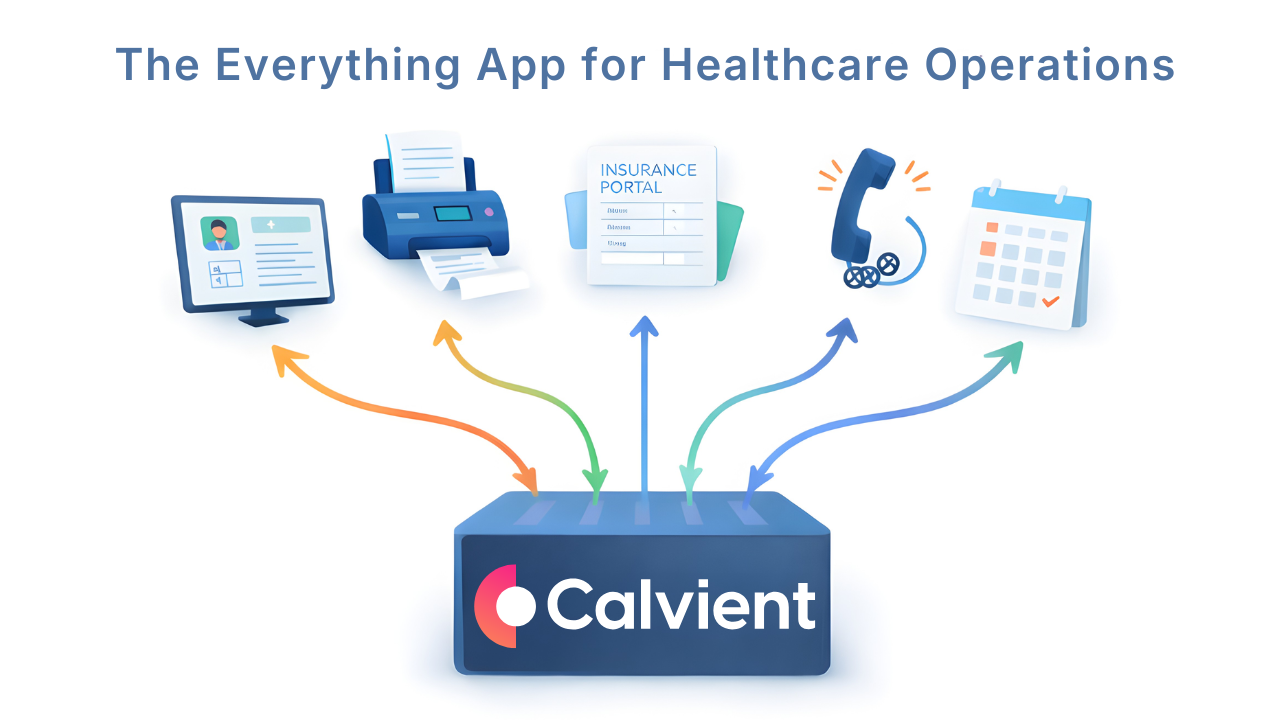
In the first post in this series, we explored the rise of everything apps: platforms like Notion and ClickUp that bring work, documentation, collaboration, automation, and reporting into one connected system. In the second, we looked at why healthcare has such an urgent need for that model. Critical operational work still lives across fax inboxes, payer portals, spreadsheets, email threads, and phone calls. Referrals, prior authorizations, medical records requests, eligibility checks, and patient follow-up are often coordinated manually, even inside sophisticated healthcare organizations. Now comes the next question: what would an everything app for healthcare actually look like?
EHRs Were Never Built to Run Operations
The EHR is essential. It is the system of record. But it was never designed to coordinate the messy operational work surrounding care. Prior authorizations, referrals, records requests, document intake, eligibility checks, and outreach still spill across faxes, portals, inboxes, spreadsheets, and phone calls. When that work lives everywhere, teams spend too much time stitching systems together by hand.
That fragmentation has real consequences. Staff chase status instead of advancing work. Leaders struggle to see where things are stuck. Important follow-up can be delayed or lost. Patients wait longer than they should. The problem is not that healthcare lacks software. The problem is that healthcare lacks a shared operational system connecting the work between systems.
What the Healthcare Everything App Should Actually Be
A true everything app for healthcare should not try to replace the EHR. It should do something more practical and more valuable: centralize incoming work, turn it into structured workflows, route it to the right people, make performance visible, and create a safe path from manual work to automation. In healthcare, the everything app is best understood as an operational command center or a workflow cockpit.
Healthcare does not need one app that literally does everything. It needs one place where operational work can happen coherently. It needs a system that works with the EHRs teams already use, while coordinating the workflows those systems were never built to manage.
Why We Built Calvient
Calvient is our answer to that need: an AI-powered healthcare operations platform built to serve as the operational layer around the EHR. Instead of asking teams to juggle scattered inboxes, trackers, portals, and queues, Calvient gives them one connected environment where operational work can be captured, prioritized, completed, and measured. It is designed for the workflows that matter most in healthcare operations, including referrals, prior authorizations, medical records, eligibility, document management, and patient communication.
With Calvient, incoming work is centralized. Faxes, emails, referrals, records, and other documents flow into one intelligent stream where they can be classified, prioritized, and routed. Instead of spending the day sorting through disconnected channels, teams can start acting on structured work.
That incoming work becomes a managed workflow. Role-based tasklists, handoffs, real-time tracking, and automated escalations make ownership clear and keep work moving. When someone is out, overloaded, or waiting on an outside party, the system preserves continuity instead of relying on memory and manual follow-up.
With Calvient, automation becomes practical. Teams can track throughput, see bottlenecks, understand where time is being lost, and automate routine steps like routing, renewals, records handling, and prep work. The goal is not to replace staff. It is to remove repetitive clerical burden so staff can focus on judgment, exceptions, and patient needs.
Why This Matters
This is more than a better interface. It is a better operating model. When intake is centralized, ownership is clear, and repetitive work is automated, organizations gain speed, visibility, and capacity at the same time. Across our current site, we point to real outcomes like 40–60% FTE time savings, 30–50% faster turnaround, and 20–30% more throughput.
Our published research and customer examples make the case very concrete. In a 12-month study across two practices, we report 2–3x labor efficiency, 60–75% less staff time spent on document processing, 6.6x more documents processed per FTE daily, and $350K in annual ROI. In another example with Oklahoma Arthritis Center, we report a 65% reduction in fax backlog, processing times cut from roughly six days to one, and more than one million pages handled annually without adding staff.
The Future of Healthcare Operations
Healthcare has more than enough disconnected point solutions. It needs a system that sits around the existing stack and makes operational work coherent. A system where inbound work is centralized, ownership is clear, bottlenecks are measurable, and automation can be introduced safely over time. That is what an everything app for healthcare should be.
That is the category Calvient is building: the everything app for healthcare operations. Or, more precisely, the workflow cockpit where teams can organize work, coordinate execution, and automate the busywork that slows care down. When operations run better, patients move faster, staff burn out less, and healthcare organizations gain the capacity to do more with the teams they already have.
Book a demo to see how Calvient helps healthcare organizations centralize intake, coordinate operational workflows, and automate the repetitive work that slows patient care.