
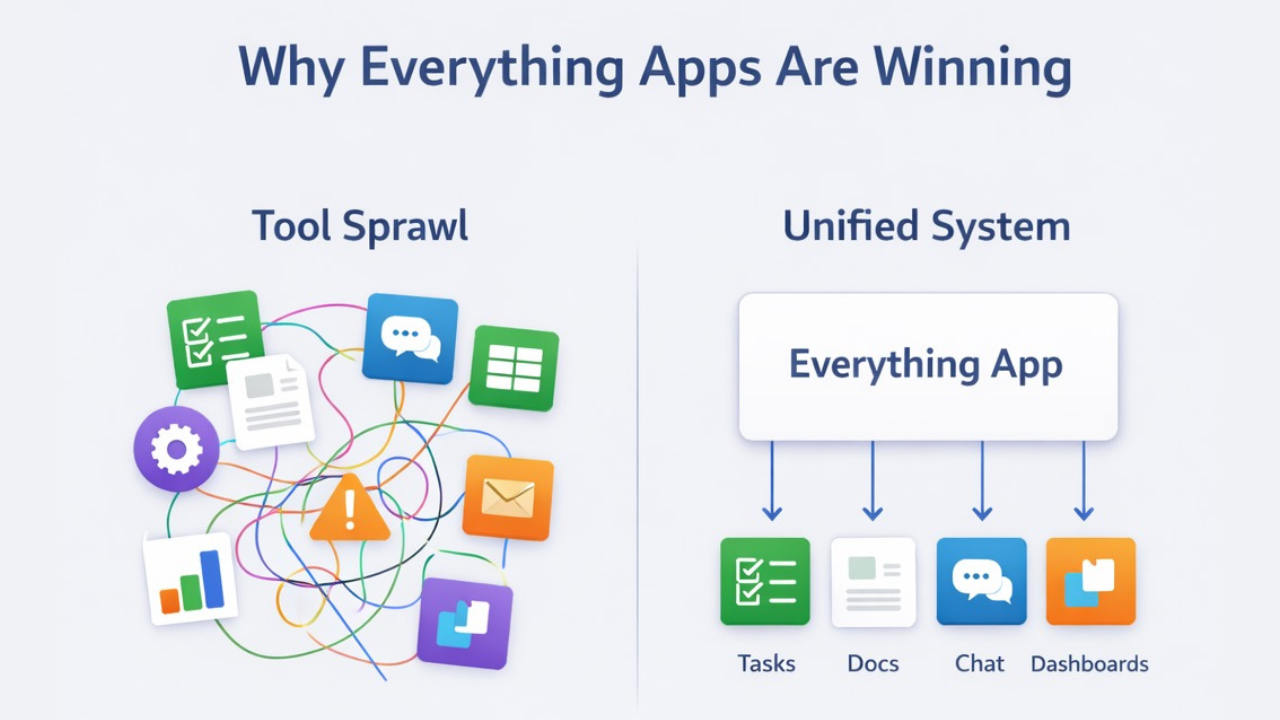
Over the last decade, organizations have slowly assembled toolboxes containing a tool for every job.
A project management tool for tasks. Slack for communication. A CRM for sales. A ticketing system for support. Spreadsheets for everything else.
Each tool solves a specific problem. Each one is “best in class.” And each one creates a new tab, a new login, a new silo.
The modern workplace runs on dozens of disconnected applications.
Now, a new category of software is emerging in response: the “everything app.”
What Is an “Everything App”?
An everything app isn’t literally everything. It’s not trying to replace email, accounting software, or your EHR.
Instead, it’s a unified operational layer, a platform where work, communication, documentation, automation, and data live together in one connected system.
Notion and ClickUp are two well-known examples. They started with a specific use case (note-taking and project management), but expanded into:
- Task management
- Documentation
- Databases
- Automation
- Collaboration
- Reporting
- AI assistance
- Integrations with other systems
Instead of forcing teams to move between five different systems to complete a workflow, everything apps consolidate the operational backbone of an organization into one environment.
And that changes how organizations work.
The Hidden Cost of Tool Sprawl
In a fragmented system every tool requires a new tab and a different login. The tools don't talk to each other which leads to a loss of precious information and context.
Everyone has experienced the frustration of having your message ignored because your coworker "doesn't really check messages on that app."
This issue arises constantly in organizations with fragmented systems. Switching between apps is tedious, communication gaps are dangerous, and confusion about the ultimate source of truth kills agility.
When systems aren't connected, people are forced to become the integration layer.
Why Everything Apps Are Gaining Momentum
When the core functions of work exist inside a shared system:
- Information becomes relational
In disconnected systems, data lives in isolation.
In unified systems:
- Tasks connect to documents.
- Documents connect to projects.
- Projects connect to metrics.
- Metrics connect to outcomes.
This relational structure allows organizations to see patterns, dependencies, and bottlenecks that would otherwise remain hidden.
2. Automation becomes practical
Automation is powerful—but only when systems can talk to each other.
Everything apps make automation native. Instead of building fragile bridges between five different tools, workflows can trigger directly inside the same ecosystem.
For example:
- When a task moves to “Complete,” notify stakeholders.
- When a document is approved, update a status dashboard.
- When a form is submitted, create a project automatically.
This lowers the technical barrier to operational maturity.
3. Collaboration becomes embedded in the work
In fragmented systems, communication is separate from execution.
In everything apps, comments live on tasks. Discussions live inside documents. Decisions are attached to projects. Feedback is contextual.
The work and the conversation about the work happen in the same place.
That reduces ambiguity and accelerates execution.
4. Organizations gain a single source of truth
Perhaps the biggest benefit: clarity.
When everyone works inside a shared operational platform:
- There’s one dashboard.
- One project status.
- One documentation hub.
- One place to check progress.
Leaders gain visibility. Teams gain alignment. New hires ramp faster. The organization becomes more coherent.
Are Everything Apps Replacing Best-in-Class Tools?
Not entirely. Everything apps don’t eliminate specialized software. They don’t replace industry-specific systems like ERPs or clinical platforms. Instead, they sit on top of those systems as the operational command center.
Think of it this way: specialized tools run critical functions while everything apps coordinate how the organization uses them.
The Tradeoff: Flexibility vs. Fragmentation
Adopting an everything app requires a mindset shift.
It asks organizations to standardize workflows. To define processes clearly. To agree on shared systems of record.
That can feel restrictive at first, but the alternative of uncontrolled tool sprawl creates far more friction over time.
The most effective organizations aren’t the ones with the most tools. They’re the ones with the fewest tools that are doing the most.
The Broad Appeal of Operational Infrastructure
We believe "everything apps" have greater staying power than most software trends as they offer complete transformation and streamlining of organization-wide workflows.
Reducing friction, enabling automation, aligning teams, and accelerating decision-making are benefits that will always be sought after by savvy executives.
In a world where speed and clarity create competitive advantage, simple and clean infrastructure matters.