
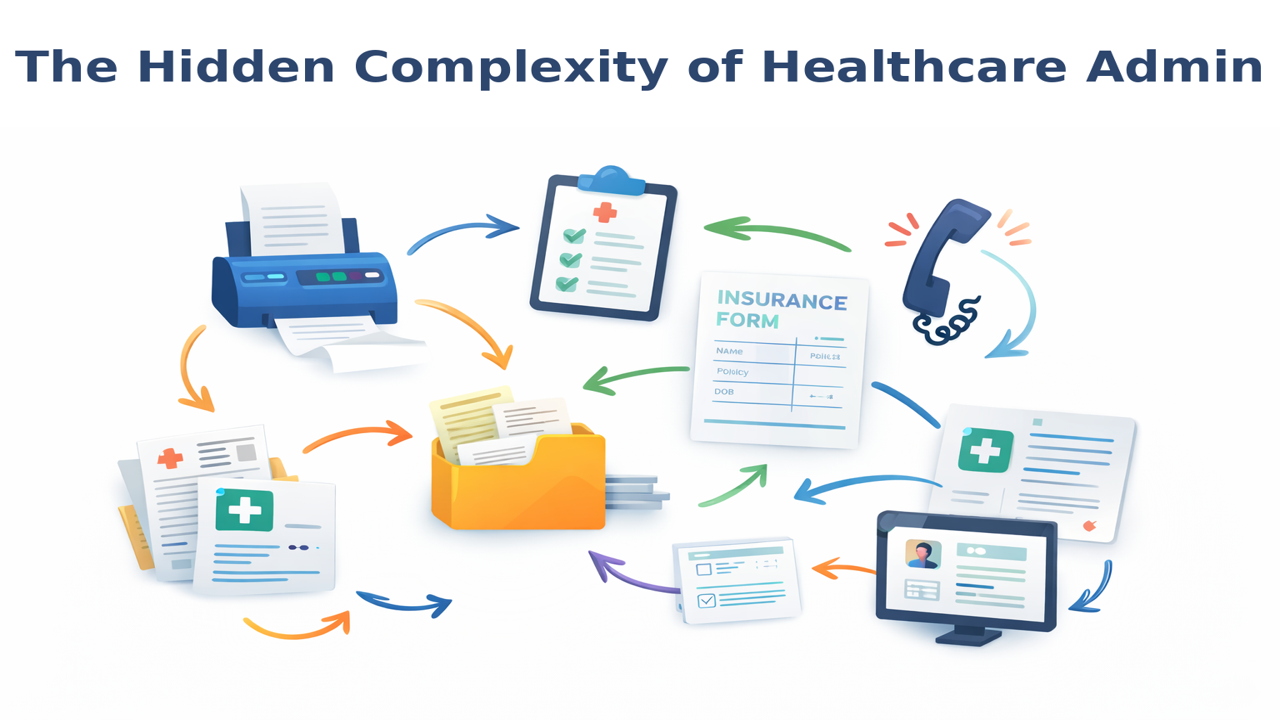
Healthcare organizations are among the most technologically advanced institutions in the world.
Hospitals operate robotic surgery systems. AI helps analyze medical imaging. Genomic sequencing is becoming routine in some specialties.
And yet, behind the scenes, many administrative workflows still run on tools and processes that look like they belong in 1995.
Fax machines. Manual data entry. Phone calls to insurance companies. Staff switching between half a dozen systems just to complete a single task.
Some of the most advanced technology as well as some of the most archaic coexist in most healthcare organizations, and this stark contrast is felt most by the administrative staff tasked with bridging the gap. It's time for infrastructural overhaul.
The Administrative Complexity of Modern Healthcare
Healthcare organizations operate in one of the most complex administrative environments of any industry. A single patient journey might require coordination between:
- Physicians and nurses
- Front office staff
- Medical records teams
- Insurance payers
- Referral networks
- Diagnostic labs
- Pharmacy systems
- Compliance and billing teams
Each of these functions might live in its own system. The result is an operational environment where information lives everywhere while workflows live nowhere.
The Daily Reality of Healthcare Administration
To understand the challenge, it helps to look at just a few of the common workflows inside healthcare organizations.
1. Prior Authorizations Before many procedures, medications, or imaging studies can be performed, providers must obtain approval from the patient’s insurance company. This process is known as prior authorization and is one of the most time-consuming administrative burdens in healthcare.
Physicians report completing roughly 40-45 prior authorization requests per week with staff spending up to 13 hours per week handling the process.
The prior auth workflow contains several steps involving filling out forms, sending/receiving faxes, making phone calls, etc. Even a small delay in one of those steps can cause a ripple effect from scheduling through patient outcomes.
When the delivery of care is being impeded by an overly complicated administrative workflow, it is clear that things need to change, processes streamlined.
2. Fax-Based Referrals and Records Remember that archaic technology mentioned earlier? Fax confusingly remains one of the most common ways that patient information moves between organizations.
Documents frequently arrive as scanned faxes that must be received, reviewed, routed, and manually entered into other systems. What should be a very simple process of moving information between systems is, in reality, a multi-step process that creates operational bottlenecks.
3. Medical Record Retrieval Another common workflow: locating and gathering patient records. Medical records may exist across multiple systems:
- The organization’s EHR
- External clinics/hospitals
- Diagnostic labs
- Payer systems
While networks exist to exchange health information, the reality is that many records still require manual searching, requesting, and uploading across systems. Administrative staff are often forced to act as the bridge between fragmented data sources.
The Hidden Cost of Administrative Fragmentation
This fragmentation has far more severe consequences than mere inconvenience and tedium.
Staff Burnout Unnecessary complexity is one of the leading drivers of physician and staff burnout. There are not many people who can happily spend hours each day completing paperwork and navigating payer portals.
Delayed Patient Care Administrative delays can postpone each step of the patient journey by days or even weeks. This is frankly unacceptable. Patients shouldn't have to worry about their care being forgotten like their order at McDonald's.
Operational Inefficiency Healthcare organizations often need to hire entire teams dedicated to administrative workflows like authorization management or medical records processing. Much of their time is spent simply coordinating between systems.
Lost Visibility When workflows span multiple tools, leadership loses visibility into operational performance. Where are authorizations getting stuck? How long do referrals take to process? Which workflows create the most delays? These are questions leadership needs to be able to answer, but the information is buried across multiple systems, requiring yet another multi-step workflow to simply unearth it.
A New Approach to Healthcare Operations
Healthcare technology has historically focused on clinical systems. Electronic health records, imaging platforms, and diagnostic systems have received enormous investment. However, the administrative layer of healthcare remains fragmented.
Instead of managing dozens of disconnected tools, many industries are implementing integrated operational platforms sometimes called "everything apps" which we wrote all about recently.
These systems bring together documentation, communication, automation, data, task management and more all into a single operational environment.
This approach is already transforming how many organizations work. Healthcare organizations may be next.
The Opportunity Ahead
Healthcare will always require specialized clinical systems, but the administrative workflows that connect those systems don’t need to remain fragmented.
Imagine a healthcare operations platform where:
- Faxes are automatically routed and processed
- Patient records are easily accessed
- Teams collaborate directly within operational tasks
- Leadership has visibility into bottlenecks across the organization
- Repetitive tasks are automated
Instead of staff stitching together workflows manually, a single system could take them through each step of the previously fragmented workflow. No more hours of tedious clerical work. No more patients getting lost in the shuffle. No more communication gaps. Efficiency, order, and visibility reign. An everything app for healthcare would surely be a hot commodity.
In our next post, we'll explore what an everything app designed specifically for healthcare would look like and how it could form a robust operational backbone for organizations everywhere.