
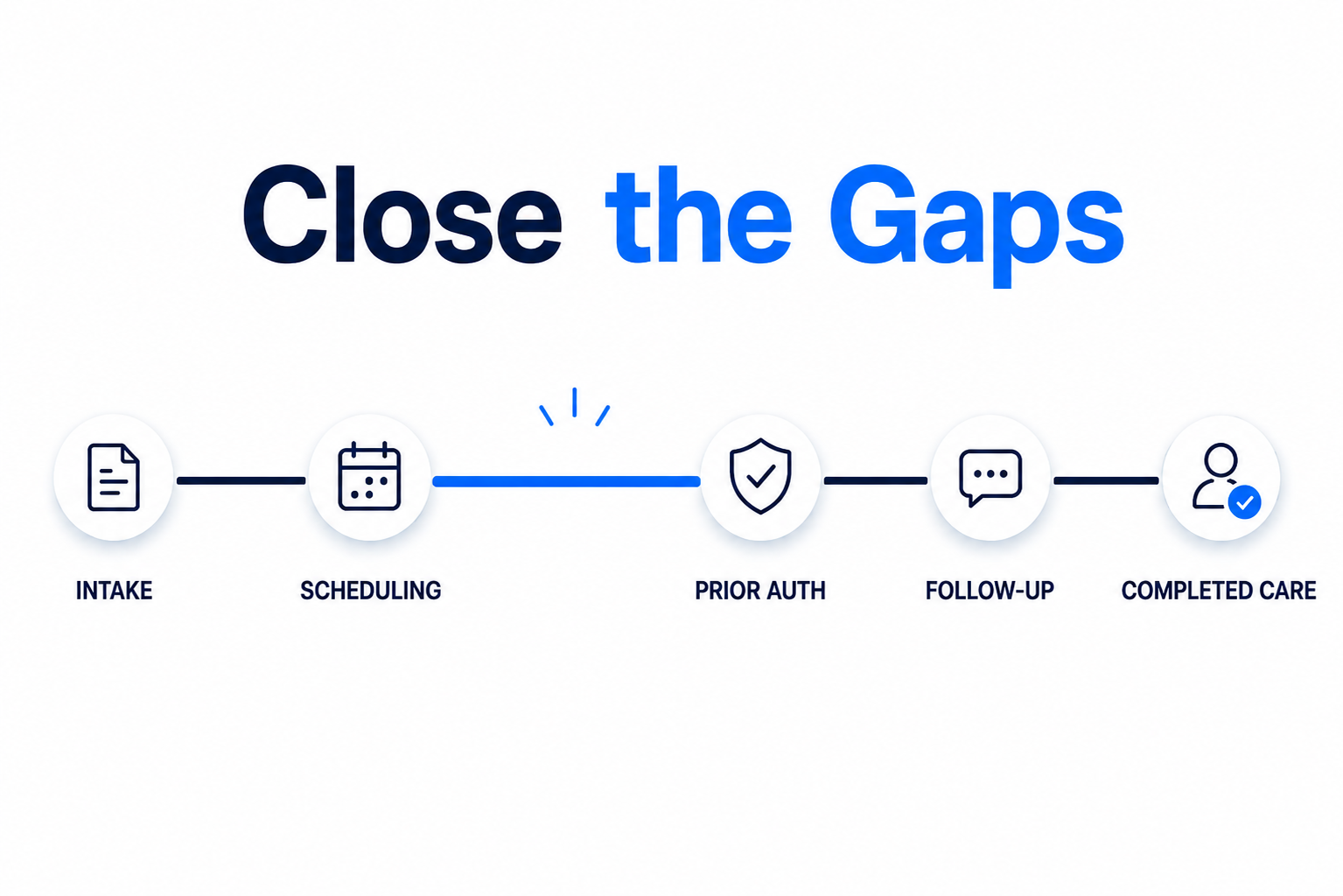

A patient does not usually disappear from care because of one single failure. More often, the patient is lost in the handoffs.
A referral arrives by fax, but the packet is missing key documentation. A coordinator starts working the case, but insurance still needs to be verified. Scheduling waits on prior authorization. Prior authorization waits on clinical notes. The patient misses the first call. A reminder goes out, but no one sees the response. The visit happens, but the consult note is never chased back.
No one intended to lose the patient, but the workflow was not built to keep them moving.
This is what we call patient access leakage: the gradual loss of patient momentum between referral intake, scheduling, prior authorization, communication, and follow-up. It shows up as delayed care, unused appointment capacity, staff frustration, open loops, and patients who eventually go elsewhere, give up, or fall out of the care plan entirely.
That is one of the gaps Calvient is built to close.
How clinics lose patients in the intake process
Patient access work usually crosses multiple teams. Referral coordinators, front desk staff, scheduling teams, prior auth specialists, revenue cycle teams, nurses, providers, and care coordinators may all touch the same patient journey. That means the patient journey depends on handoffs, and handoffs are where leakage happens.
The first point of leakage is often intake. Incoming work may arrive by a variety of channels. Each channel may have a different owner, a different queue, and a different process. When intake is scattered, teams lose time figuring out what arrived, what it is, who it belongs to, and what should happen next.
Calvient helps healthcare teams centralize inbound operational work from fax, forms, documents, and communications into one queue. From there, incoming items can be classified, structured, routed, and assigned so they become actionable work instead of loose documents.
How clinics lose patients in the referral process
Referral workflows create another common leakage point. A referral may arrive without all the required information. The case may look like it is moving, but it is not actually ready. When missing information is not caught early, scheduling and prior authorization teams often discover the same gaps later, creating delays and rework.
A better referral workflow does more than store the referral. It tracks completeness, ownership, communication, scheduling status, and closure. Calvient’s referral management workflows are designed to help teams move from incoming referral to completed loop with clearer visibility at every step.
How clinics lose patients in the scheduling process
Scheduling can also create leakage when it is disconnected from readiness. Scheduling is more complex than just finding an open slot. For many visits, the patient needs to be operationally ready before that slot is useful. Forms may need to be completed. Insurance may need to be updated. Procedure instructions may need to be understood. A prior authorization may need to be approved before the appointment can proceed.
When scheduling and readiness live in separate workflows, clinics fill calendars with appointments that are still fragile. Calvient helps teams coordinate appointment-driven tasks like reminders, paperwork, insurance updates, and readiness exceptions before the visit becomes a last-minute scramble.
How clinics lose patients in the prior auth process
Prior authorization is another major source of patient access leakage. When auth status is unclear, patients wait. When payer responses are not tracked, staff chase manually. When denials or missing-item requests are buried in portals or faxes, the workflow stalls. When an authorization expires or is not renewed in time, scheduling and revenue both suffer.
Calvient supports prior auth and payer operations by helping teams coordinate eligibility checks, benefits verification, submission readiness, payer follow-up, aging, renewals, and exceptions in one operating flow. Prior auth will always require judgment and oversight, but repetitive status chasing and manual follow-up should not depend on memory.
How clinics lose patients in the follow-up process
Finally, clinics often lose patients because outreach is treated like messaging instead of workflow. A reminder is not the same thing as follow-up. A patient may reply that they need to reschedule, but the response sits in a thread. A no-show may occur, but no recovery task is created. A patient may not respond after multiple attempts, but there is no escalation path.
Patient communication only reduces leakage when it creates action. Calvient helps connect reminders, recall, no-show recovery, surveys, and follow-up outreach to downstream tasks so patient responses can be routed, tracked, and resolved.
Why staffing alone does not solve the problem
When patient access teams are overwhelmed, the natural response is to add people. Sometimes that is necessary, but staffing alone does not fix leakage if the underlying workflow remains fragmented.
A new coordinator can help work a queue, but only if the queue is visible. A prior auth specialist can chase payer responses, but only if the case state is clear. A scheduler can call patients, but only if they know which patients are ready, which are blocked, and why. A manager can rebalance workloads, but only if backlog, aging, and throughput are measurable.
Patient access improvement is not just a staffing problem. It is a coordination problem. Clinics need a way to make work visible, assign ownership, automate repetitive steps, escalate exceptions, and measure where patients are getting stuck.
What better patient access looks like
A better patient access workflow does not require replacing the EHR. It requires an operational layer that connects the work around the EHR: intake, routing, ownership, status, communications, automation, exceptions, and reporting. Strong patient access operations should answer five questions at every step:
- Who owns this task right now?
- What is the next step?
- What information is missing?
- How long has it been waiting?
- What has to happen before the loop is closed?
When those questions are easy to answer, teams can move faster with more control. When they are hard to answer, work gets delayed, duplicated, or even dropped.
Calvient’s AI-powered workflow automation is designed to make sure those questions always have answers. It helps healthcare teams turn scattered work into structured execution while keeping staff involved where judgment, ambiguity, or escalation is required.
Just as importantly, leaders need visibility into where work stalls. A team can be diligent and efficient while still losing patients. To reduce leakage, clinics need to track where referrals age, where prior auths get stuck, where patients fail to schedule, where no-shows are not recovered, and where follow-up loops remain open.
The most important question shouldn't be how many tasks were completed or how many patients were treated. Instead, it should be, "How many patients were we unable to get to the next step?"
How Calvient helps close the loop
Calvient helps healthcare teams replace fragmented operational work with one system for intake, follow-up, task ownership, reporting, and AI-assisted workflow execution.
Calvient is not designed to make clinical decisions. It is designed to handle administrative and operational work, while surfacing steps that require staff judgment with the right context attached. That is how patient access teams gain speed without ceding control.
Patients need the next step to be clear. Staff need the next action to be owned. Leaders need visibility into where work is stuck. Referring providers need updates. Prior auth teams need status. Schedulers need readiness. Outreach teams need response-aware follow-up. And every workflow needs a clear definition of completion.
The best that a fractured system involving all these needs and steps can hope to create is a fragile loop that can snap at the smallest snag. The worst case is an open faucet spilling desperate patients into the ether.
Calvient helps healthcare teams move from scattered work to structured execution, so referral intake, scheduling, prior authorization, and follow-up do not live in separate silos. They become part of one connected operational workflow.
See how Calvient can connect and streamline your workflows
Bring us one patient access workflow, and we will show you how we can close and reinforce the loop. We will map the handoffs, automate the tedious and repetitive tasks, and help you identify the path to a cleaner and more consistent workflow.
Book a demo to see what we can do for you specific pain points.