
Growth is usually a good sign for a healthcare organization. More patients mean more people are receiving care and the organization is expanding its reach, but this naturally leads to an operational challenge. As patient volume rises, so does the administrative work required to support it. If an organization is not prepared to scale, suddenly even routine workflows can become bottlenecks.
One healthcare organization we work with recently faced this problem in its Health Information Department. Before implementing Calvient, the department processed approximately 38,000 to 40,000 documents every month. Every single document needed to be manually reviewed, classified, and routed making for an average of around of four minutes spent on each one.
Document volume was also growing by 8.1% annually. Under the existing model, keeping up with that growth would require staffing to increase at nearly the same rate as document volume. The organization needed a way to support continued growth without continually adding more administrative work to an already busy team.
Beginning With a Measurable Workflow
The organization selected Calvient to help automate several of the most repetitive steps in document processing:
- Classifying incoming documents
- Automatically archiving eligible documents
- Routing documents that still required human review
The implementation was approached conservatively. The original business case allowed for a year of observation so the organization could evaluate real performance before making broader operational decisions.
As it turned out, the organization did not have to wait a year to see meaningful results.
What Happened Within 90 Days
Within 90 days of going live, Calvient exceeded the organization's original first-year projections. By the second month:
- 66,906 documents were processed during the month
- 26,002 documents were automatically archived
- Touchless automation rate reached 35%
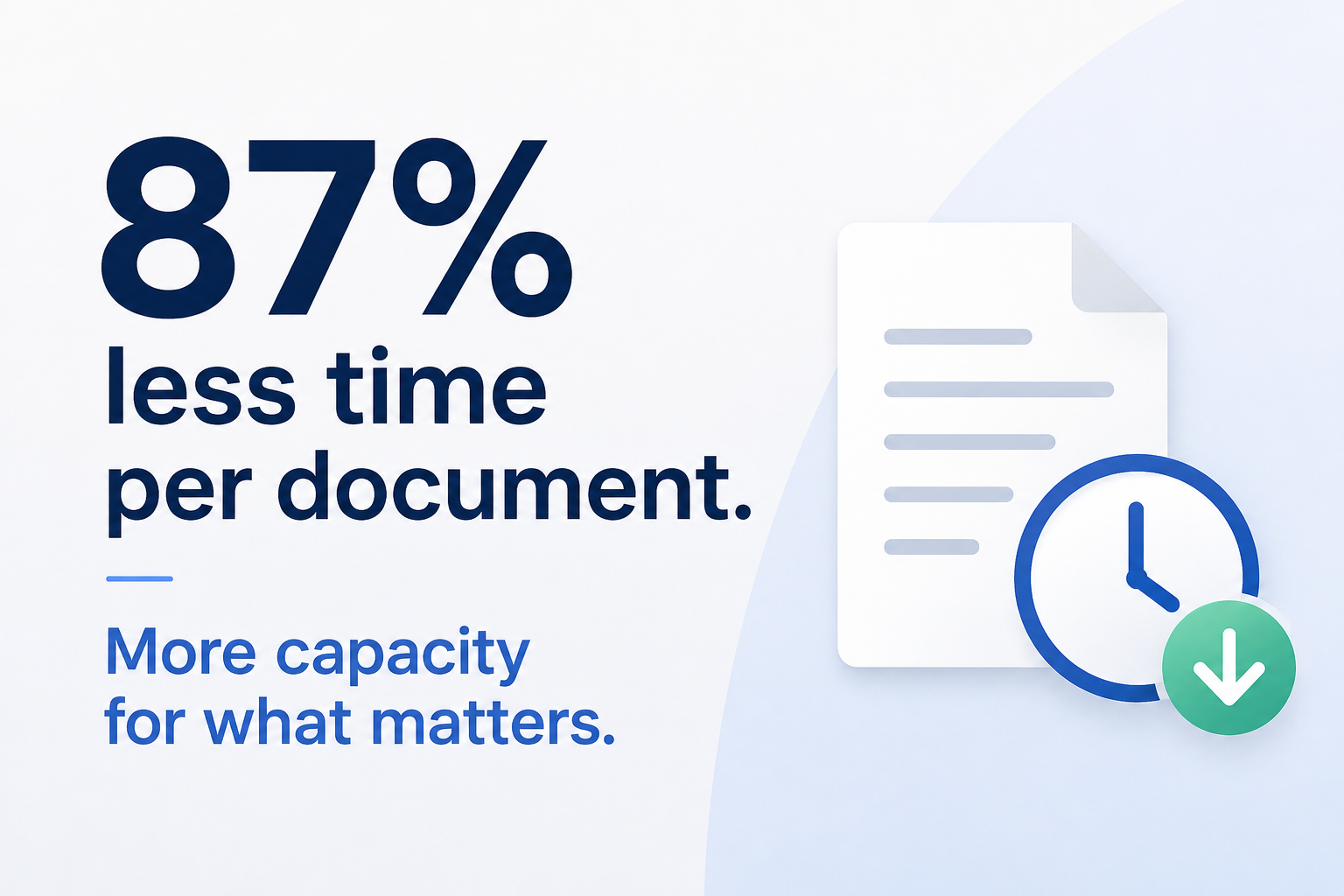
- Document handling time fell from 4 minutes to 30 seconds Together, these numbers represent a roughly 87% reduction in average document handling time. It was evident that Calvient simultaneously helped scale operations while also freeing up time in the day for staff.
Separating Growth From Headcount Growth
Calvient helped break the direct relationship between document growth and staffing growth. The organization demonstrated that it could manage substantially more volume without requiring a proportional increase in administrative labor.
Without Calvient, adding patients often means adding documents. Adding documents means adding staff. Over time, operational costs rise proportionally to patient volume even though the underlying work remains rote.
Instead, our partner was able to create a more scalable model. Routine documents process automatically while documents requiring attention are presented to the exact person that needs to see it. As a result, scaling patient care no longer requires scaling headcount.
Keeping People Where Human Judgment Matters
A 35% automation rate means many documents still received human review. That might indicate room for improvement, but it should be noted that having complete document automation is never the goal. We want to make sure that tasks involving complex contextual decisions or patient safety considerations always have human oversight.
The goals was always to automate appropriate work while making human work faster and more manageable. That is where operational AI can provide the greatest value: not by attempting to remove people from every process, but by removing repetitive steps that prevent people from concentrating on more meaningful work.
Turning New Capacity Into New Opportunities
The capacity created through automation can now be applied elsewhere. The organization identified several additional workflows that currently still require significant staff attention which can now be targeted for automation redesign.
While the initial implementation was scoped to just document processing with Calvient, there are many more opportunities for efficiency gains using our platform.
The organization is also applying the same implementation framework to its referral operations. That process will include workflow assessment, a controlled pilot, staff training, operational stabilization, and a 90-day period of live performance measurement before longer-term conclusions are drawn.
This serves as a repeatable model for successful scaling. Start with a high-volume workflow. Establish a reliable baseline. Introduce automation with appropriate oversight. Measure actual results. Then, repeat with other operational challenges.
Calvient offers a robust suite of solutions for whatever might ail a healthcare organization. When users are committed to utilizing that power, operational evolution is only a matter of time.
Building a More Scalable Healthcare Operation
To recap, in just 90 days, Calvient helped one healthcare organization:
- Increase monthly document capacity by 67%
- Reduce document handling time by 87%
- Reach touchless automation rate of 35%
- Preserve human review for work requiring judgment
- Create additional staff capacity for other operational priorities
Healthcare organizations should not have to choose between growth and overwhelming their teams. By combining intelligent automation with human oversight, Calvient helps organizations manage increasing volume while allowing their existing staff to spend less time on repetitive processing and more time supporting the work that matters.
See how Calvient can help your organization build the operational capacity to grow.